Protecting nature costs money, and the world is still falling well short of what's needed.
The 2026 Biodiversity Finance Trends Dashboard was launched at the start of the 17th UN Biodiversity Conference.
Produced by the UK government and The Nature Conservancy, the dashboard tracks how much finance is flowing towards protecting nature, and how much there is still to go. It shows where things are moving in the right direction, and where the gaps are.
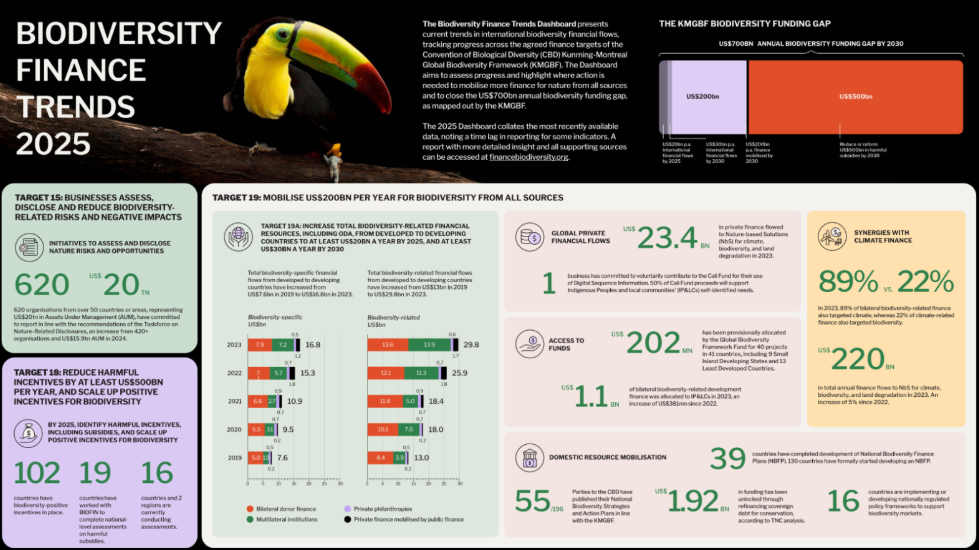
To halt and reverse biodiversity loss by 2030 will require at least $200 billion for nature. Plus, at least $500 billion a year that is currently spent on incentives that harm nature needs to be reduced or redirected.
International finance is rising, and businesses are taking notice of nature
The Dashboard shows that finance flowing from developed to developing countries to protect nature has more than doubled since 2019, to almost $19 billion in 2024.
It’s good progress, but it's a stepping stone: by 2030, international finance needs to reach $30 billion a year, as part of the wider $200 billion a year from all sources. Keeping up this pace of growth is essential.
Businesses are also taking nature risk more seriously. More than 800 organisations across 50-plus countries, managing $26.2 trillion in assets, have now committed to reporting on how their businesses depend on nature, and how their businesses impact nature.
This matters because it helps organisations understand their risks and responsibilities when it comes to looking after nature which they rely upon.
Private money is starting to flow too. The Dashboard showcases the Cali Fund which allows businesses to put direct finance back into nature. It allows companies that profit from genetic data from nature to contribute and to protect it, with at least half of that money set aside to support indigenous peoples and local communities.
So far, five businesses have contributed or committed to contribute. It's early days, but it's a promising route for private finance to flow towards and support nature.
Progress on cutting funding that harms nature is slow but steady
Countries have committed to reducing subsidies and incentives that harm nature by at least $500 billion a year by 2030 – and there are positive signs that action is being taken.
105 countries now have nature-friendly incentives in place, and 39 have completed full reviews of their harmful subsidies using the United Nations Development Programme Biodiversity Finance Initiative guidance, with many more underway or planned.
However, spotting harmful incentives is just the first step. Countries now need to reduce or redirect these incentives fairly, and in a way that supports people through the change.
Getting money where it's needed, and countries building their own plans
Global funding targets only matter if the finance raised reaches the people and places that can use it.
The Global Biodiversity Framework Fund has so far allocated $362 million to 82 projects in 87 countries, including many small island and least developed nations.
In the Solomon Islands, the fund has empowered local communities to protect 20,000 hectares of critical ecosystems by creating a community-led trust fund and promoting sustainable, women-led businesses.
Many countries are also developing their own national plans for financing nature protection: 41 have completed these, and 136 more have started.
Meanwhile, 19 countries and regions are developing or exploring biodiversity credit schemes, an emerging approach that will need strong rules to ensure it works as intended.
What this all means
This year's Dashboard shows real signs of progress: more international funding, more businesses reporting on nature risk, closer scrutiny of harmful subsidies, and more countries building their own plans.
But the $700 billion gap will not close through any one source of funding alone. Governments, businesses, investors and development organisations all have a part to play, both in raising new money and in redirecting funding that currently works against nature.
Clear, accurate data like this helps everyone see what's working, where the gaps are, and where more international co-operation is needed, as countries move from promises to action.
Read the full 2026 Biodiversity Finance Trends Dashboard and technical annex.
Leave a comment